
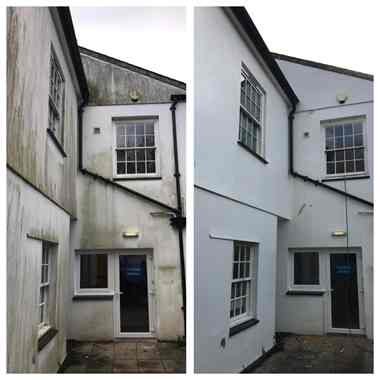
What you are actually looking at
Three things colonise render in this part of the country, and most walls have some combination of all three.
- Green film is algae. It needs moisture and light, spreads quickly, and is the first thing to appear on a damp wall.
- Black streaking is generally airborne algae and cyanobacteria that darken as they build up in layers. It is the stuff that runs in vertical stripes down an otherwise clean elevation.
- Grey, crusty patches are lichen — a slow-growing partnership of fungus and alga that roots into the surface texture and is the hardest of the three to shift.
All of them are alive. That single fact explains everything else about how render should and should not be cleaned.
Why it appears where it appears
Growth on render is not random, and the pattern usually tells you what is feeding it.
Streaks running down from gutter joints mean water is escaping and running down the face rather than into the downpipe. Dark bands under window sills mean the sill is not throwing water clear — often a blocked or missing drip groove underneath. Green at ground level is splash-back from paths and hard surfaces, sometimes combined with soil bridging the damp course. Whole-elevation greening is almost always a north-facing wall, a wall in permanent tree shade, or both.
North Dorset and South Somerset are close to ideal conditions for this: mild, wet, sheltered valleys with high humidity and plenty of trees. Render greening here is normal maintenance, not evidence that anything is wrong with the house.
Why the obvious approaches fail
Scrubbing and detergent
Household cleaners lift surface dirt. They do not kill algae, and they cannot reach the growth that has rooted into the render’s texture. You get a temporarily lighter wall and a full return within a few months.
Pressure washing
This is the one that causes lasting damage, and it is depressingly common. Render is a comparatively thin coating over a wall that is supposed to stay dry. Putting a lance on it does three things at once: it erodes the finish, it opens up hairline cracks and drives water into them, and it forces moisture behind the coating.
The result is a wall that looks clean for a season, then develops patchy dark staining coming out from the inside, or blown sections where water has got behind and frozen. Neither can be cleaned off, because the problem is no longer on the surface. Monocouche and silicone-based renders like K-Rend are particularly unforgiving — their whole performance depends on an intact factory surface.
Painting over it
Masonry paint over untreated growth traps living organisms under the film. It comes back through, and now you have a paint problem as well as an algae problem. If a wall is going to be painted, it needs to be killed off and clean first.
How render is properly cleaned
The correct method is a softwash: a treatment applied at very low pressure that kills the organisms, followed by time. Nothing is scoured off, so the render is not touched.
- Protect first. Borders, plants, windows, ponds and drains covered before anything is applied.
- Apply at low pressure. The treatment is put on evenly and given time to work — this is a dwell process, not a blasting process.
- Let it break down. A softwashed wall keeps improving for weeks afterwards as the dead growth weathers off. That is the process working, not failing.
- Fix the cause. Clear the gutters, sort the leaking joint, cut back the overhanging branch. Otherwise you are on a two-year cycle forever.
Different renders want slightly different handling. Old sand-and-cement render is tolerant. Pebbledash holds growth deep in its texture and takes longer. Lime render on older properties needs the gentlest approach of the lot. Painted masonry depends entirely on the condition of the paint. A quick look at photographs is normally enough to tell which you have.
When it is not algae at all
Not every mark on a render wall is growth, and cleaning the wrong problem is a waste of money. Worth ruling out:
- Damp coming through. A persistent dark patch that never fully dries, especially near ground level or around a chimney, is usually water, not algae.
- Failed or blown render. Tap it — a hollow sound means the render has parted from the wall behind. That needs a plasterer, not a cleaner.
- Rust staining. Orange-brown runs from bell beads, brackets or wall ties are corrosion, and cleaning will not remove the source.
- Efflorescence. White powdery bloom is salt being carried out of the wall by moisture. It brushes off, then comes back until the moisture is dealt with.
If a wall has any of these, we will say so rather than clean over the top of it.
Keeping it off for longer
You cannot stop growth entirely in a damp valley climate, but you can slow it down considerably. Keep gutters and downpipes clear so water goes where it should. Cut back overhanging branches to get light and air onto the wall. Make sure soil and mulch are not banked up against the render. Check that window sills are actually throwing water clear of the face.
Do those four things and a treated wall will hold its finish for years rather than needing attention every other summer.
What it costs
Render cleaning is priced on the size of the elevations, how bad the growth is, how many sides of the property are affected and the access. Two or three photographs from the ground are usually enough for a fixed price, without anyone needing to visit. That is how most of our render cleaning work is quoted.
Will softwashing damage my render?
No. Nothing is scoured off — the treatment kills the growth and the surface is left exactly as it was. It is a jet wash that damages render, not a softwash.
How soon will the wall look clean?
There is usually noticeable change straight away, but the full result develops over the following weeks as dead growth breaks down and weathers off. Heavy lichen takes the longest.
Can K-Rend and monocouche be cleaned?
Yes, with a softwash. They should never be pressure washed — their performance depends on the factory surface staying intact, and once it is eroded it cannot be restored.
Do you clean conservatories and uPVC at the same time?
Yes, and it usually makes sense to. Frames, glazing and fascias respond to the same low-pressure approach and doing them together saves a second visit.
How often does render need cleaning?
On a treated wall with clear gutters and reasonable light, several years. A shaded north elevation under trees will always want doing more often.
Read next, or get a price.
Walls gone green?
Send a photo of the worst elevation and we will tell you what is causing it and what it would cost to put right.