
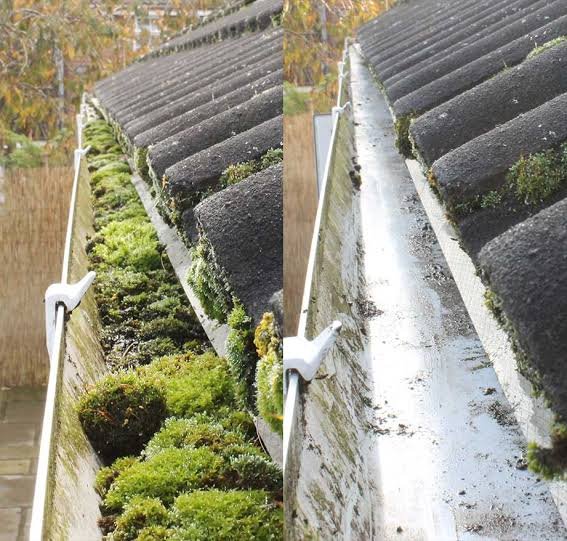
Why autumn, specifically
Two things happen at once between late September and the end of November. Leaves come down, and the growing season for moss begins again as the weather turns damp and mild. In a sheltered valley like the Blackmore Vale, where the air stays humid and the tree cover is heavy, both arrive with force.
Leaves alone are manageable. Leaves plus moss shed from the roof plus the grit that comes off ageing concrete tiles makes a dense, water-holding plug that sits in the gutter and does not move on its own. By the time you notice water spilling over the edge in a downpour, the gutter has usually been partly blocked for months.
What a blocked gutter actually does
People picture an overflow and think of it as a nuisance. The real problem is where the water goes instead.
- Down the wall. Water running down render or stone soaks in, and the wet strip that results is exactly where algae and black staining establish themselves. Most of the streaked elevations we are called to clean start at a gutter joint.
- Into the wall. Persistently saturated masonry carries moisture inwards. Internal damp patches that appear on an upstairs wall in January are very often a gutter problem from October.
- Behind the fascia. Standing water rots timber fascia and soffit boards from the back, where nobody sees it until the paint blisters or a board gives way.
- Into the ground at the wrong place. Water dumped at the base of a wall rather than into a drain saturates the ground, which is not what anyone wants against a foundation over a wet winter.
- Freeze and split. A gutter full of wet debris holds water. Water freezes, expands, and cracks joints and brackets. Plastic guttering that has survived a decade can fail in a single hard frost.
What to check from the ground
You do not need to climb anything to spot most of it. On the next wet day, walk round the outside and look for:
- Water pouring over the front edge of the gutter instead of running along it
- A steady drip from a joint between two lengths, or where the gutter meets the downpipe
- Plants growing out of the gutter — grass, buddleia seedlings, anything green above head height is a fully established blockage
- A dark vertical streak on the wall below a joint, which is the tell-tale for a leak that has been going a while
- A downpipe that stays dry during heavy rain when the others are running
Any one of those is worth acting on before winter rather than after.
Why it is part of a roof clean
When a roof is cleaned, a substantial amount of moss comes down. If it is left in the gutters, the clean has swapped one problem for a worse one. That is why clearing gutters and downpipes is included in every roof clean we do rather than quoted as an extra — a roof clean that leaves blocked gutters is not a finished job.
It also makes the roof treatment last longer. Standing water at the eaves keeps the lowest courses of tile permanently damp, and that is where regrowth starts first.
Doing it yourself, safely
Single-storey gutters over a solid, level surface are a reasonable DIY job with a proper ladder and someone footing it. Beyond that, be honest about it: falls from ladders are among the most common serious accidents in the home, and gutters are at exactly the height that hurts. Two-storey work, anything over a conservatory roof, sloping ground, or a gutter you cannot reach without stretching is not worth the risk to save a modest sum.
How often
Once a year for most properties, in late autumn once the leaves are down. Houses with trees directly overhead want checking twice — once in early autumn and again after leaf fall finishes. Properties on open ground with no trees can often stretch to every other year, though roofs shedding moss will still fill them.
Wherever you are across North Dorset and South Somerset, the pattern is the same: the work is small, the timing matters, and the cost of skipping it lands somewhere more expensive.
Do you clear gutters as a standalone job?
Yes, and as part of any roof clean. If you only need the gutters done, that is a perfectly normal job to book on its own.
How do I know if the downpipe is blocked rather than the gutter?
If the gutter overflows at one end but the downpipe stays dry during heavy rain, the blockage is in the pipe. Those often clear with rodding rather than needing anything replaced.
Are gutter guards worth fitting?
They help on properties with heavy leaf fall, but they are not maintenance-free — fine debris and moss still collect on top and need clearing. They reduce the frequency rather than removing the job.
Read next, or get a price.
Gutters overflowing already?
Send a photo and we will come back with a fixed price within 24 hours — on its own, or alongside a roof clean.