
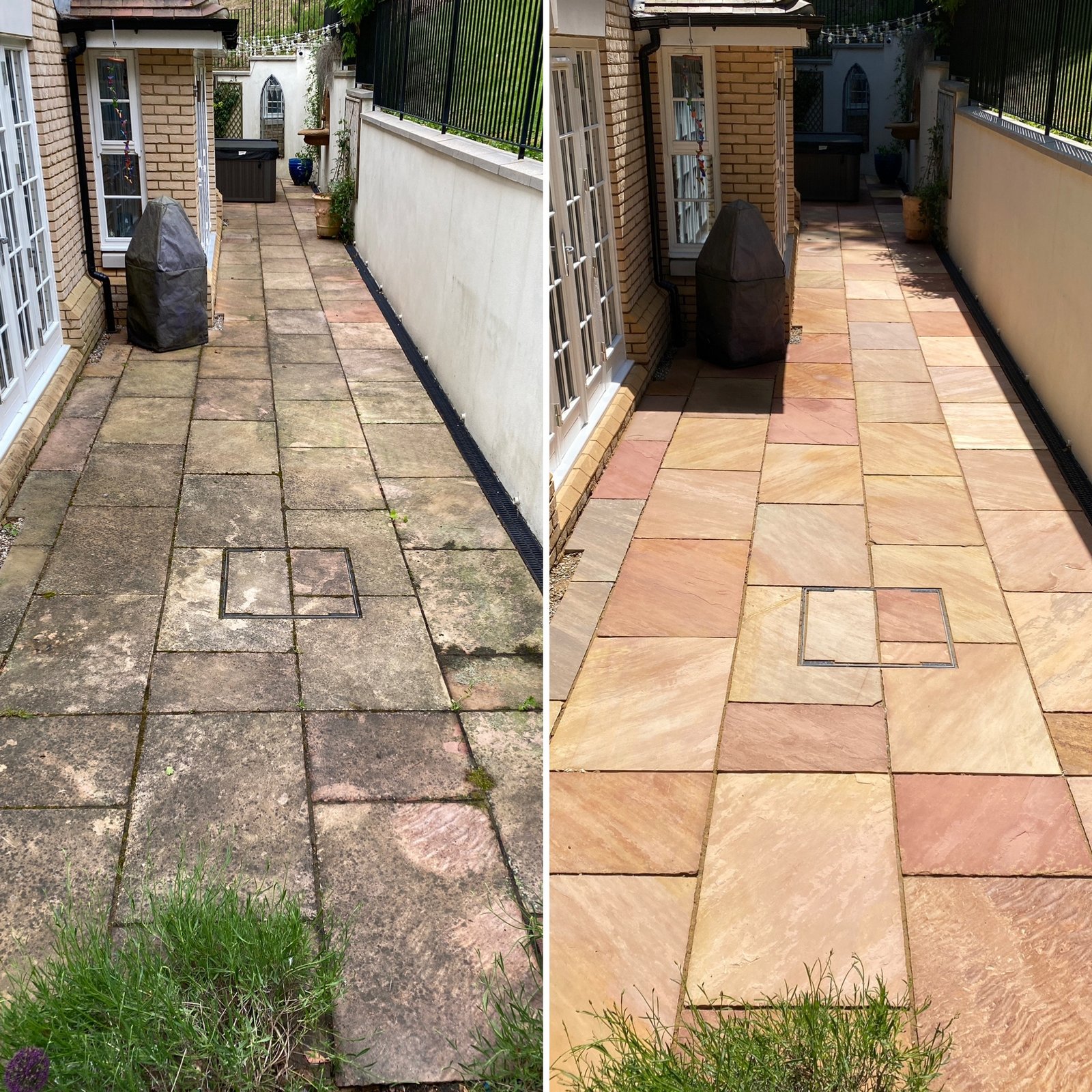
What you are actually slipping on
The thin green-black film that appears on paving in autumn is algae. It is a living organism, it is microscopically thin, and when wet it behaves like oil on glass. That is the crucial difference between algae and ordinary dirt: dirt gets muddy, algae gets frictionless.
It needs three things — moisture, low light and a surface with enough texture to grip. Autumn supplies the first two in quantity. Days shorten, the sun drops low enough that walls and hedges shade the paving for most of the day, and the ground stops drying out between showers. Growth that was held in check all summer takes off in a fortnight.
Why it is worse on some patios than others
Two houses on the same street can have completely different problems, and it usually comes down to the stone and the aspect.
- Indian sandstone is porous and textured, which is exactly what algae wants. It is the most common patio material in the county and the one that greens up fastest.
- Riven and split-faced stone has thousands of small hollows that hold water. More surface area, more moisture, more growth.
- Porcelain is nearly non-porous and stays comparatively clear — but it is also the slipperiest of the lot once a film does form, because there is no texture underneath to provide grip.
- Old concrete slabs lose their dense surface over the years and become progressively more absorbent, which is why a patio that was fine for a decade suddenly is not.
- North-facing and tree-shaded beats material every time. A shaded porcelain patio will green up faster than a sunny sandstone one.
What not to do
Do not reach for bleach or patio cleaner from a supermarket. It bleaches the colour out of natural stone unevenly, kills whatever it runs into in the borders, and goes down the drain. The green usually returns within weeks because nothing has been done about what is growing in the surface.
Do not attack sandstone with a turbo nozzle. Sandstone is soft. Held in one place, a rotary head will pit the face permanently, and pitted stone holds more water and greens up faster afterwards. You can make the problem worse in about four seconds.
Do not seal a green patio. Sealing traps the growth under the film and locks the moisture in. If a patio is going to be sealed, it needs to be cleaned, treated and thoroughly dry first.
How it is properly dealt with
A patio is a hard, sacrificial surface, so unlike a roof or render it can take pressure — but the pressure has to be matched to the stone, and the job does not end with the wash. Done properly it runs: clear the surface, wash evenly at a pressure the material tolerates, hand-work the edges and joints where growth is most established, remove the slurry rather than flushing it into the borders, and re-point or re-sand the joints where needed.
On softer or older stone, a treatment does more of the work than the water does, in the same way it would on render. Full detail is on the patio cleaning page.
Timing
Autumn is a perfectly sensible time to have it done — you get the winter with a safe surface, which is the point. Spring is the other natural slot, ahead of the season when you actually want to sit out. What is not worth doing is waiting until someone has gone over on it.
If the patio is on the shaded side of a house in Sherborne, Shaftesbury or anywhere else with mature trees close by, assume it will need attention every year or two rather than every five.
Will cleaning stop it coming back?
It resets the surface, and a treatment afterwards slows the return considerably. In a damp shaded spot nothing stops it permanently — light and airflow are what keep algae down, and you cannot change the aspect of a garden.
Is a patio cleaner from the DIY shop any use?
For a small area of concrete, at a push. On natural stone the risk of patchy bleaching is real, and most of them do not kill what is rooted in the surface, so the result is short-lived.
Should I have it sealed afterwards?
Sometimes. It slows regrowth and makes future cleans easier, but the surface must be completely dry first and not every stone benefits. We will give you a straight answer for your particular patio rather than selling it as standard.
Read next, or get a price.
Patio gone green?
Send a photo and we will come back with a fixed price within 24 hours — and an honest view on whether it needs sealing.