
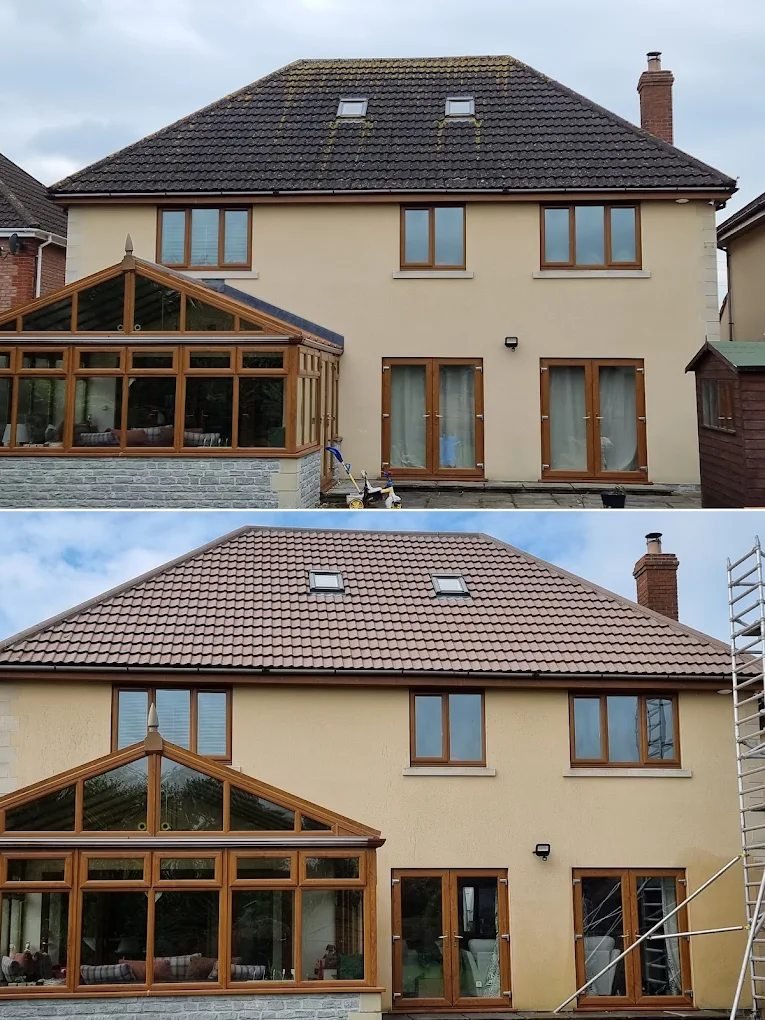
The mechanism, simply
A cushion of moss on a tile behaves like a sponge. It absorbs rain and holds it against the tile surface for days after the weather has cleared, where a bare tile would have shed the water and dried within hours.
When the temperature drops below freezing, that trapped water expands as it turns to ice. It expands inside the pores of the tile, in the tiny cracks in its surface, and in the laps where one tile overlaps the next. Each freeze levers things fractionally apart; each thaw lets more water in. Repeat that across a winter and across years, and concrete tiles begin to break down.
What frost damage actually looks like
It rarely announces itself. The signs are worth knowing because they show up long before anything leaks:
- Grit in the gutters. Fine concrete particles washing off the tiles are the surface breaking down. This is usually the first sign anyone can see from the ground.
- Tiles losing their colour unevenly — patches where the dense outer face has gone and the lighter, more porous body is exposed.
- Flaking or shaling at the tile edges, particularly on the bottom courses.
- Slipped or lifted tiles, where heavy growth in the lap has pushed the tile out of position over time.
- Damp inside at an upstairs wall or ceiling, which is the point at which it stops being a maintenance question.
Is it too late to do anything in winter?
Not necessarily, but the honest answer is that autumn and spring are better windows. Softwashing works best when the treatment has time to act and the surface is not freezing overnight, so a hard cold snap will move a job. Hand clearing is possible in more conditions, though nobody sensible is working at height in high winds or on frosted tiles.
What can be done at any time of year is clearing the gutters, which is where a lot of the winter damage actually gets caused — see the autumn gutter guide. That is the job to prioritise if you only do one thing before the cold sets in.
Why scraping alone stores up the problem
Removing the visible moss makes the roof look better and does genuinely reduce the water-holding. But scraping leaves the spores and root structures in the tile surface, so regrowth starts from an established foothold and is often visible again by the following autumn. You end up on an annual cycle, and every visit means someone else up on the tiles.
The treatment afterwards is what changes the timescale. Softwashing is a chemical process rather than a pressure one — a biocide at very low pressure that kills the organism rather than removing its body, so regrowth has to begin from nothing. That is why a treated roof measures its life in years rather than months. More on the roof cleaning page and in how to get rid of roof moss.
One thing never to do in frost. Do not pressure wash a roof at any time of year, but especially not in winter. Driving water under the laps of a tile immediately before a freeze is close to the worst thing you can do to a roof — you are putting water exactly where it will do the most damage when it expands.
Which roofs suffer most round here
Frost damage compounds where moss grows heaviest, so the pattern follows shade and damp. North-facing slopes, roofs under trees, and properties down in the valleys of the Blackmore Vale collect more growth and therefore take more frost damage than exposed hilltop houses at Shaftesbury. Older concrete tiles that have already lost some of their factory surface are the most vulnerable of all, because they are porous to start with.
If you are in Sturminster Newton, Blandford Forum or the villages between, a north-facing roof with a decent covering of moss is worth looking at before the winter rather than after it.
Can you clean a roof in winter?
Sometimes, but frost, high winds and persistent rain all move jobs, and softwash treatments want reasonable conditions to work properly. We would rather rebook than do it badly.
How do I know if my tiles are already damaged?
Grit accumulating in the gutters and uneven patches of lighter colour on the tiles are the two clearest signs from ground level. Send a photo and we will tell you what we are looking at.
If tiles are already breaking down, is cleaning worth it?
Often not. Cleaning a roof that is failing spends money without fixing anything, and in some cases makes it worse. That is a repair conversation, and we will tell you so.
Read next, or get a price.
Roof covered in moss?
Send a photo from the ground and we will come back with a fixed price within 24 hours — and an honest answer on whether it needs doing at all.