
Home / Render Cleaning
Render Cleaning in Somerset & Dorset
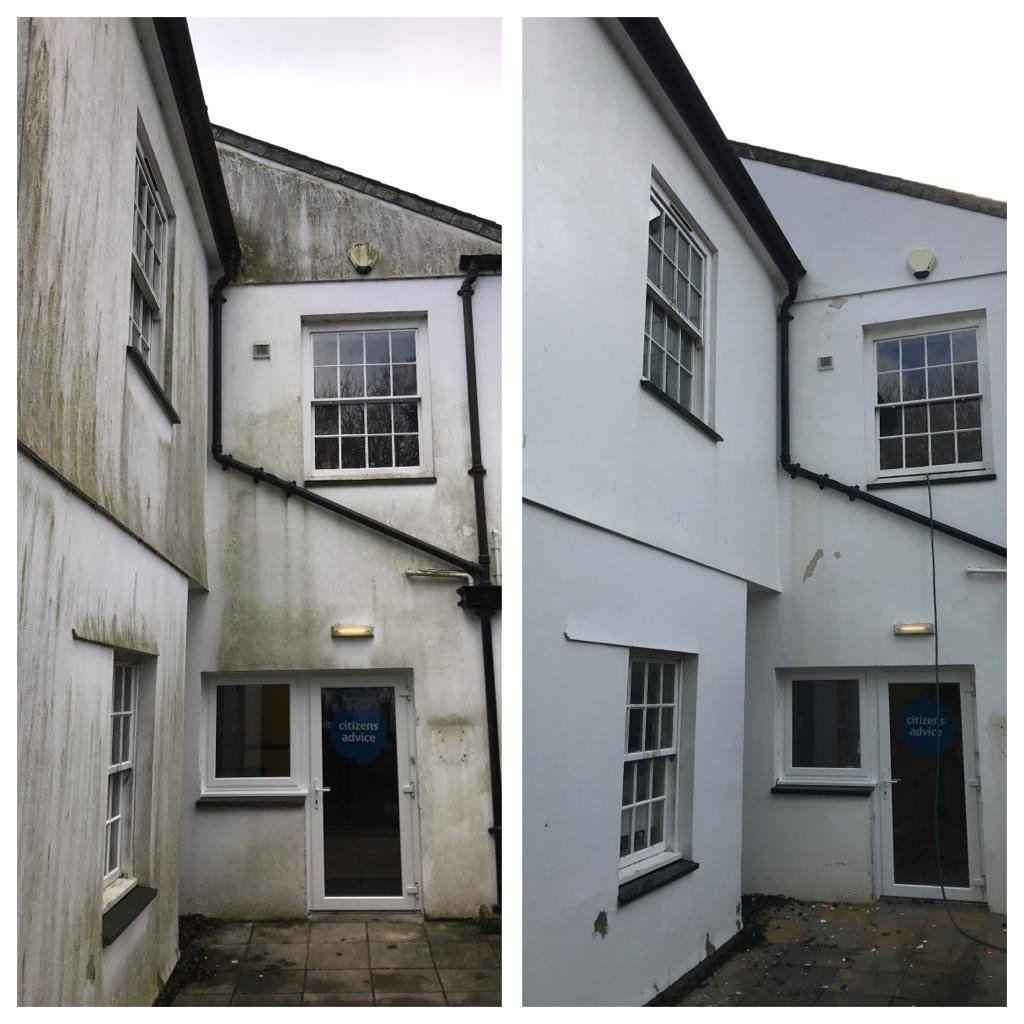
Green algae and black streaking lifted off K-Rend, silicone, pebbledash and painted render. Softwashing is a chemical process, not a pressure one — a biocide applied at very low pressure that kills the growth instead of blasting it off the wall.
Clean walls, intact render.
Modern render is a thin, textured coating over insulation or blockwork. A pressure washer will happily blast it straight off the wall, and once it is gone the only fix is re-rendering. So we never use one.
Before anything is applied we check what render you actually have and what condition it is in. K-Rend, silicone, pebbledash and painted render all behave differently, and a wall that is already cracked or blown needs repair before it needs cleaning — we will tell you that rather than take the job.
Softwashing is a chemical process rather than a pressure one, and that distinction is the whole point. A biocide is applied at very low pressure and does the work itself — killing the algae, lichen and bacteria living in and on the surface. Nothing is scoured off, which is exactly why the render survives it.
Once the growth is dead it loses its grip, and black streaking and green film keep lifting and weathering off over the days that follow. Windows, doors, borders, planting and paths are covered before we start and rinsed down once we have finished.
Three steps, no surprises.
Send a photo
A couple of shots of the affected walls tells us the render type and how far the growth has gone.
Get a fixed price
A clear written price based on the elevations being treated, with no hidden extras added later.
We treat it
The biocide goes on at low pressure, is left to do its work, then rinsed down. Some staining keeps lifting for days after we leave.
The black streaking is alive.
The dark runs down a rendered wall are almost never dirt. Black algae cleaning is a different job from washing a wall down, because what you are looking at is a living colony growing in the surface, fed by damp and shade rather than by anything in the air.
That is why rinsing it makes so little difference, and why it comes back so quickly when someone does manage to blast it off. Remove the surface layer and the growth underneath simply carries on.
Softwashing treats the cause instead. The biocide kills the algae in the render, and the black staining then lifts and weathers off over the days that follow. Our guide on why render goes black and green explains what is actually happening on the wall.
Not just render.
The same low-pressure treatment works on far more than rendered walls. Brick cleaning across Somerset and Dorset is a regular part of this work — green growth on north-facing brick, black algae on older stock, and the staining that builds up on shaded elevations.
Natural stone, lime-rendered elevations and modern cladding are all handled the same careful way, and for the same reason: soft, porous and historic surfaces are the ones pressure washing ruins fastest.
Shaded elevations are always the worst affected, and a north-facing wall will green up long before the rest of the building does.
Questions, answered straight.
Can you pressure wash render?
You can, and people do — but it is how render ends up patchy, pitted or off the wall entirely. Silicone and K-Rend in particular are easily damaged. Everything we do on render is low-pressure softwash.
Is softwashing a chemical treatment?
Yes — that is precisely what it is, and it is why it works without pressure. A biocide is applied at low pressure and kills the algae, lichen and bacteria growing in the render. Nothing is blasted off the wall, which is what keeps the surface intact. The dead growth then breaks down and weathers away over the following days.
Is it safe for plants, pets and drains?
Used at the correct dilution and applied properly, yes. Borders, planting, ponds and drains are covered before we start and everything is washed down before we leave. Keep pets indoors while we are on site and there is nothing to worry about once the wall is dry.
Will it damage my paintwork or windows?
No. The treatment is applied at low pressure and everything around it is protected first. Frames, glass and sills get rinsed down as part of the job.
The wall still looks patchy when you leave. Is that normal?
Yes, and it is worth knowing in advance. Softwash keeps working after application, so render often carries on lightening for several days. What you see on the day is not the finished result.
What is the black streaking on my render?
Black algae. It is a living growth sitting in the surface of the render, not dirt or pollution, which is why washing it down does so little and why it returns quickly if it is only removed from the surface. A low-pressure biocide kills it in the wall, and the staining then lifts over the following days.
Do you clean brick as well as render?
Yes — brick, natural stone, lime render and cladding are all cleaned the same low-pressure way. Older brick and soft stone are exactly the surfaces that pressure washing damages, so the treatment-led approach matters even more on them than it does on modern render.
Do you clean pebbledash?
Yes. Pebbledash, roughcast, painted render and smooth modern systems are all fine — the method changes slightly depending on which one you have.
How often does render need cleaning?
Most properties are on a three to five year cycle. North-facing walls and anything under trees will green up faster.
We also clean…
Areas we cover.
Based near Sturminster Newton and working right across North Dorset and South Somerset. Pick your town for the local detail, or just ask — if you are anywhere near this list, you are in it.
Ready to see the difference?
Send a photo of your render and we will come back to you with a clear, fixed price within 24 hours. Free, no obligation, no pressure.