
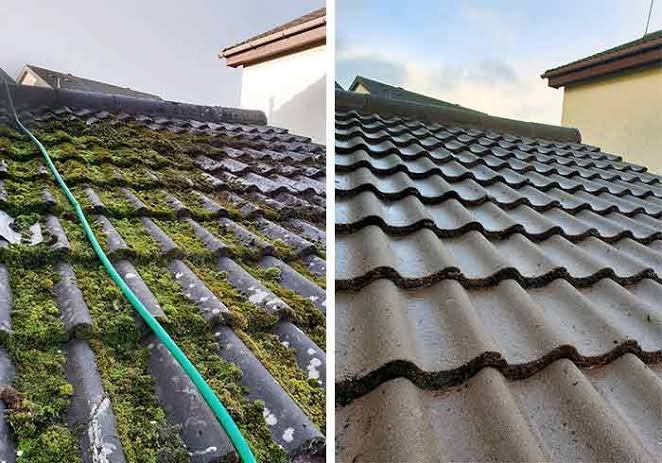
What lichen actually is
Lichen is not a plant and it is not a moss. It is a partnership between a fungus and an alga, living together as one organism. The alga makes food from light; the fungus gives it a structure and anchors it to whatever it is growing on. On a roof, that means the surface of your tiles.
You will usually see it in one of three forms:
- Flat, crusty patches in grey, white, yellow or orange, pressed tight against the tile. These are the most common on concrete and clay tiles and the hardest to shift.
- Leafy, flaky growth that lifts slightly at the edges, often grey-green, and usually on older or more sheltered roofs.
- Small, bushy tufts, which are less common on roofs and tend to show up near trees and on north-facing slopes.
Lichen grows slowly, which is why people often do not notice it until it covers a good part of the roof. By then it has been there for years.
Why scraping and brushing never finish the job
Moss is a loose cushion. It holds on, but most of it comes away with a scraper, which is why hand clearing is the first step of every roof we clean. Lichen is different. The fungal part of it grows down into the tiny pores and texture of the tile, so the bit you can see is only part of the organism.
Scrape it and you take off the top layer and leave the anchor behind. Within a season or two it grows back from exactly the same spots. Scrape harder and you start taking the surface of the tile with it, which leaves a rough, scarred patch that holds water and gives the next growth an even better foothold.
Why pressure washing makes it worse
A pressure washer will shift lichen. It will also shift the factory surface of a concrete tile, drive water sideways under the laps and into the roof space, and loosen tiles and ridge pointing. The roof looks clean for a few months, then greens over faster than before because the tiles are now rougher and more porous. We never put a pressure lance on a roof, and we would always rather tell someone to leave it than do that. Our guide to softwashing vs pressure washing covers which surfaces can take pressure and which cannot.
What actually removes roof lichen
The answer is to kill it where it is, rather than try to tear it off. That is what a softwash and biocide treatment does.
- Clear the bulk by hand. Moss and loose growth come off first, from a safe access platform, with gutters and downpipes cleared of what comes down.
- Softwash at low pressure. A biocide goes on across the whole roof at very low pressure. Nothing is blasted; the treatment does the work.
- Let it weather away. Dead lichen does not drop off on the day. It loosens and washes away gradually over the following weeks as rain and weather get to it. That slow fade is the treatment working, not failing.
- Protect the surroundings. Borders, planting and drains are covered before anything goes on, and everything is washed down before we leave.
Because the treatment kills what is living in the tile rather than just what is sitting on top of it, a treated roof stays clear for years rather than months. That is why the biocide is included on every roof we clean rather than offered as an extra. There is more on the full method on our roof cleaning page.
Does lichen damage a roof?
On its own, lichen is slower and less obviously harmful than thick moss. It does not hold water in the same way and it rarely blocks gutters by itself. But it does keep the tile surface damp, it slowly roughens the surface it grows on, and it is very often growing alongside moss and algae that do cause problems. A roof with heavy lichen is usually a roof that is staying wet for too long.
Old stone is a slightly different case. On a sound stone wall or an old stone roof, lichen often does no structural harm, and on some historic buildings it is part of the character. Where that is the situation, we will say so rather than sell a clean nobody needs.
Why it is so common in Somerset and Dorset
Lichen loves clean air, moisture and shelter, and this part of the country has all three. Damp valleys around Bruton and the Blackmore Vale, low ground near Martock and the Levels, and roofs shaded by mature trees all stay wet for long periods. North-facing slopes, which see little direct sun in winter, are almost always the worst side of the roof. If the north slope is crusted and the south slope is fairly clear, that is the reason.
It also means that on most roofs round here, regrowth is a question of when, not if. The aim is to push that as far into the future as possible, which is exactly what the treatment does.
Keeping it off for longer
You cannot change the climate, but a few things genuinely slow lichen down. Cut back overhanging branches so the roof gets light and air and dries out faster. Keep gutters clear so water leaves the roof rather than sitting at the eaves. And have the roof treated, not just scraped, so whatever is living in the tile is dealt with. Our guide to getting rid of roof moss covers the moss side of the same problem.
How do you remove lichen from roof tiles?
By killing it rather than scraping it. Loose growth and moss are cleared by hand first, then the whole roof gets a low-pressure softwash with a biocide. The dead lichen loosens and weathers away over the following weeks.
Why is the lichen still there the day after the treatment?
Because dead lichen does not fall off straight away. It is still anchored to the tile, and it takes rain and time to loosen and wash it off. That gradual fade is normal and is the treatment doing its job.
Can I just pressure wash lichen off my roof?
It will move the lichen, but it also strips the surface of the tiles, forces water under the laps and can loosen tiles and pointing. The roof then regrows faster. Roofs should only ever be hand cleared and softwashed.
Is lichen on a stone wall a problem?
Not always. On a sound stone wall, lichen often does no structural harm. If the stone is old and soft, the honest advice may be to leave it, or to clean it very gently rather than risk damaging the face of the stone.
Read next, or get a price.
Roof gone crusty?
Send a photo of the roof from the ground and we will tell you what is growing on it and what it would cost to treat properly.