
It is not the wood that is slippery
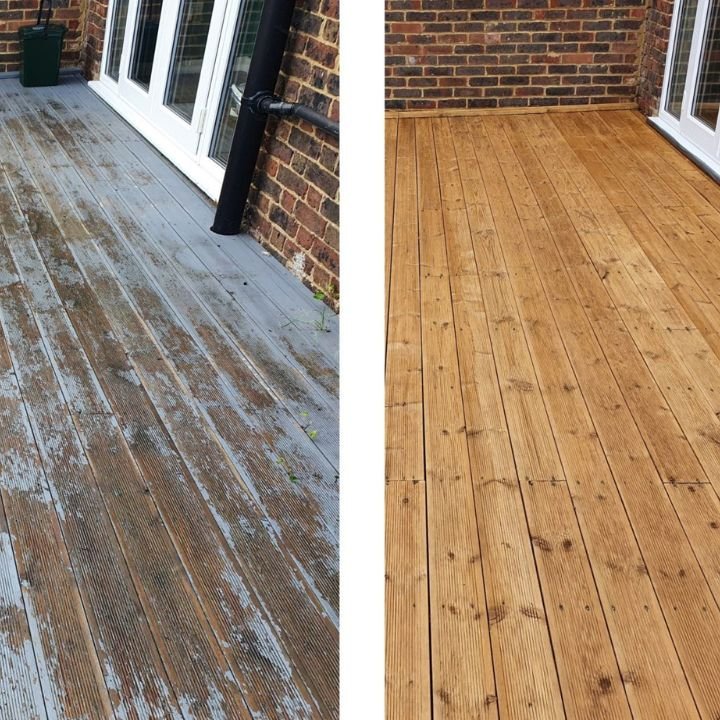
Bare, clean, dry timber has decent grip. What turns decking treacherous is the biofilm growing on and in it — algae, mould and the fine organic layer that builds up from leaf litter and shade. Once that is wet, the coefficient of friction collapses. People describe it as being like ice, and that is not far off.
Autumn brings all of it together: leaves dropping and sitting on the boards, shorter drying windows, and a surface that stays damp from one shower to the next. A deck that was perfectly fine in August can be genuinely unsafe by the end of October.
Why grooved boards are worse, not better
This surprises people. Reeded or grooved decking was sold for years on the basis that the ridges provide grip. In practice the grooves run the length of the board, hold water and debris, and stay wet long after a smooth board has dried. They also give algae a sheltered channel to establish in.
Smooth boards, kept clean, generally out-perform grooved ones for grip. If you have grooved decking, it needs cleaning more often rather than less.
Why it is always worse under trees
Shade, leaf fall and high humidity are the three things that decide how fast a deck deteriorates, and a garden deck tucked into a shaded corner gets all three. Across the villages of North Dorset and South Somerset, decks under mature trees are reliably the worst we see — often silver-grey, furred with algae, and with the boards beginning to soften at the ends where water sits.
The same deck in an open, sunny position might need attention every three or four years. Under a beech, every year.
What damages decking during cleaning
Timber is soft and has grain, which makes it easy to wreck with enthusiasm:
- Too much pressure tears out the softer spring growth between the harder grain lines. The board ends up furred, rough and with a much larger surface area for algae to colonise — so it greens up faster afterwards than it did before.
- Working across the grain leaves visible stripes and raises the fibres. Cleaning runs along the board, with the grain, every time.
- A turbo nozzle held still carves a channel into the timber in about two seconds.
- Neat bleach whitens the wood unevenly, attacks the fixings, and runs off into whatever is planted beside it.
Done properly it is a low-pressure job worked along the grain, with a treatment doing most of the work on the growth rather than the water doing it by force. Detail on the decking restoration page.
Do not oil it yet
The common autumn mistake is to clean a deck and immediately oil or stain it to “protect it for winter”. Timber needs to be genuinely dry before any finish goes on — days of dry weather, not hours. Seal damp wood and you trap moisture in the board, which is how you get a finish that lifts and flakes by February.
Cleaning in autumn is sensible, because it makes the deck safe for the months it is most dangerous. Oiling is a spring job. Doing the first now and the second later is the right sequence, not a compromise.
When cleaning is not the answer
Push a screwdriver gently into the end grain of a board, particularly near a joist or where the deck meets the house. If it sinks in easily, that board is rotten and cleaning it is pointless. Soft boards, loose fixings and any movement in the frame are a carpentry job first. We will say so rather than take payment for washing a deck that needs rebuilding.
Will cleaning make it non-slip again?
It restores the grip bare timber naturally has, which is a substantial improvement. Nothing makes decking grippy when soaking wet, so on a shaded deck used year-round, anti-slip strips on the steps are worth considering.
Can composite decking be cleaned the same way?
It needs a gentler approach — composite scratches and marks more easily than people expect, and heavy pressure damages the surface permanently. It still gets algae; it just is not maintenance-free.
How long until it needs doing again?
Open and sunny, three to four years. Shaded and under trees, annually. The aspect matters far more than the timber.
Deck gone green and slippery?
Send a photo and we will come back with a fixed price within 24 hours — and tell you honestly if any boards need replacing first.