The confusion is understandable
Almost everyone searching for exterior cleaning has the same mental model: a machine, a lance, and water coming out hard. Turn the pressure up for stubborn dirt, turn it down for delicate things. That model is wrong, and it is wrong in a way that costs people money.
Softwashing is not “pressure washing on a low setting”. It is a different process with a different mechanism. Understanding the difference takes about two minutes and will tell you immediately whether the person quoting for your roof knows what they are doing.
What pressure washing actually does
Pressure washing is mechanical. Water at high velocity physically knocks material off a surface — dirt, algae, moss, loose sand, old sealant, and, if you are not careful, the surface itself.
It is genuinely the right tool for hard, dense, sacrificial surfaces. Concrete, block paving, most patio slabs, tarmac, brick paviours and stone flags that are in good condition can all take a lance without complaint, because the material is tough and there is no thin protective layer sitting on top of it that matters.
The problem is that “it removes what is on the surface” is only half of what happens. Everything that comes off has to go somewhere, and pressure that is enough to shift lichen off a tile is also enough to shift the tile’s factory surface, force water sideways under laps and joints, and drive moisture into a wall that was previously keeping it out.
What softwashing actually does
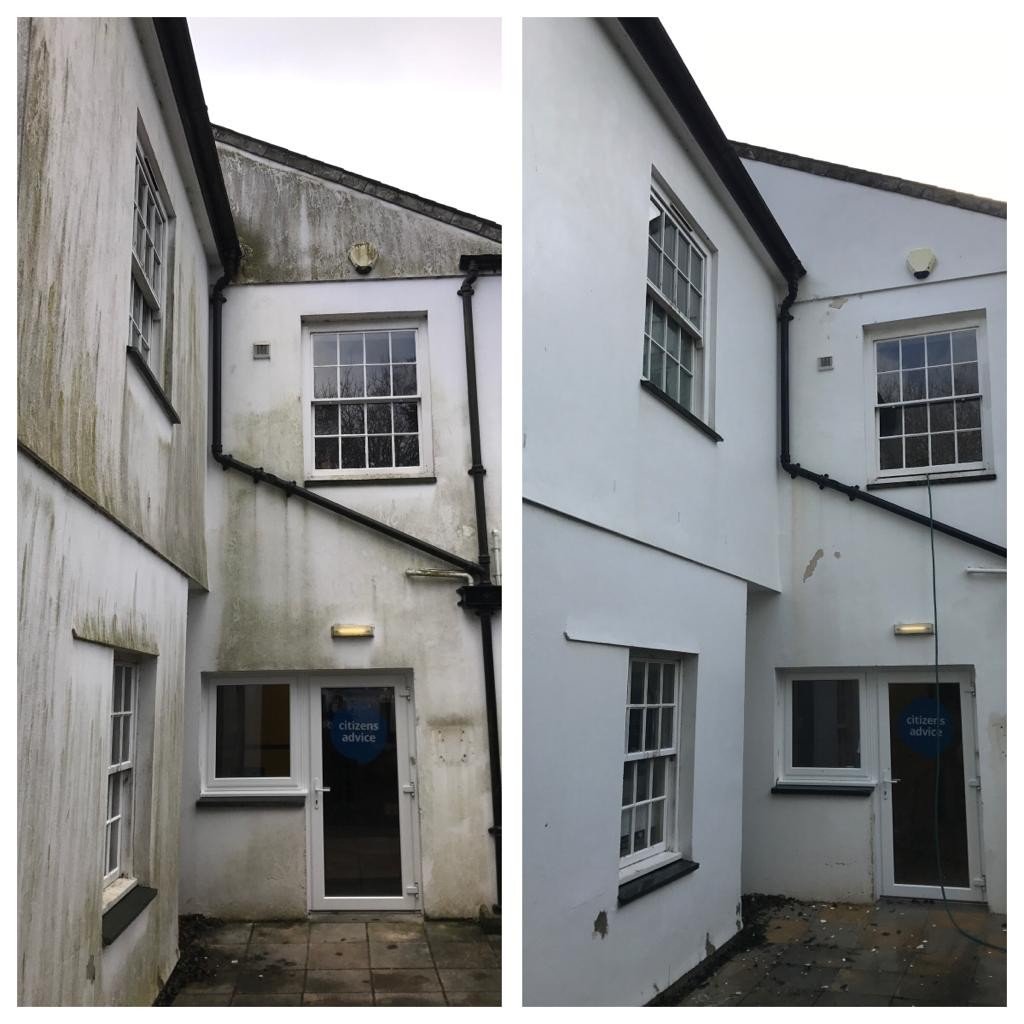
Softwashing is chemical. A treatment is applied at very low pressure — often little more than a garden sprayer or a fan tip at a fraction of a lance’s output — and it kills the organisms living on and in the surface. Algae, lichen, moss spores and the biofilm that holds them all in place die off, and then weather and time take the residue away.
The two things people find surprising about softwashing are that it is slower and that it looks like nothing much is happening while it is being done. A softwashed roof often keeps improving for weeks afterwards as the dead growth breaks down and washes off in the rain. That is the process working, not the process failing.
The advantage is that nothing is being physically removed by force. The surface is untouched. Tiles keep their face, render keeps its coating, old stone keeps the weathered skin it took a century to grow.
Why the treatment outlasts the clean
There is a second advantage that matters more than the first. Pressure washing removes the visible growth but leaves the spores and root structures behind — which is why a blasted roof or a scrubbed render wall greens up again quickly, sometimes within a single season. A biocide treatment kills the organism rather than removing its body, so regrowth starts from nothing rather than from a foothold.
That is the whole reason a properly treated roof stays clear for years and a jet-washed one does not.
Which surface gets which
| Surface | Method | Why |
|---|---|---|
| Tiled or slate roof | Softwash + hand clearing | Pressure strips the tile face, dislodges tiles and drives water under the laps |
| Painted or textured render | Softwash only | A lance removes the coating and opens hairline cracks into water paths |
| Old or soft stone | Softwash, low pressure | The weathered face is the protection; strip it and the stone starts to break down |
| uPVC, conservatories, fascias | Softwash | Seals, trims and glazing gaskets do not survive repeated high pressure |
| Block paving | Pressure wash + re-sand | Dense and sacrificial; the jointing sand is replaced afterwards |
| Concrete and stone patios | Pressure wash, matched to the stone | Tough enough, but sandstone and limestone need the pressure dialled down |
| Tarmac | Pressure wash + re-colour | Cleaning lifts the surface colour, so a restorer goes back on afterwards |
| Timber decking | Low pressure, along the grain | Too much pressure furs the timber and raises the grain permanently |
What pressure damage looks like
The uncomfortable part of this job is that the damage usually does not show up on the day. A blasted roof looks fantastic that afternoon. The problems arrive later:
- Roof tiles that shed and shale. Concrete tiles have a dense outer face. Strip it and the porous body underneath absorbs water, freezes, and starts breaking up — typically two or three winters later.
- Render that stains from within. Water forced behind a coating comes back out through the face as patchy dark marks that no amount of cleaning removes.
- Stone that goes powdery. Soft limestone loses its weathered skin, then starts shedding face. It does not grow back.
- Damp inside. Water driven under laps or into wall junctions turns up as an internal problem months later, and nobody connects it to the driveway man who did the roof as a favour.
- Paving that sinks and wanders. Block paving washed and not re-sanded loses the interlock that holds it together, and the edges start to move.
None of these get blamed on the clean, because by the time they appear the clean is a distant memory. That is exactly why the industry gets away with it.
The exceptions people get wrong
Two things regularly catch people out. The first is that a low-pressure setting on a pressure washer is not softwashing. Turning the dial down still means water hitting a surface mechanically with no treatment involved; it is a weaker version of the wrong process. Softwashing requires the chemistry.
The second is that softwashing is not automatically the gentle option for every job. Nobody softwashes a block driveway; it would be slow, expensive and would not clear the joints. Choosing the method is about the material, not about caution.
How to tell what you are being sold
You do not need to understand the chemistry to ask three questions:
- “What pressure will you be using on the roof?” If the answer involves a lance or a rotary head on tiles, stop there.
- “What treatment goes on afterwards?” If there is no treatment, you are paying for a result that will not last.
- “What happens to the gutters?” A roof clean puts a lot of material into them. If clearing them is priced as an extra, the quote was not thought through.
Anyone who has been doing this properly for any length of time will answer all three without hesitating, and will tell you when a surface should be repaired rather than cleaned. That last one is the real test.
In short
Pressure washing is for hard, sacrificial, ground-level surfaces — and it is very good at those. Softwashing is for everything on the building itself: roofs, render, uPVC, and old stone. Most exterior cleaning damage in Somerset and Dorset comes down to somebody using the first where the second belonged.
Is softwashing safe for plants and pets?
Used at the correct dilution and with borders, ponds and drains protected, yes. Everything is washed down before we leave. Keep pets indoors while the work is being done and there is nothing to worry about once surfaces are dry.
How long does a softwash take to show results?
Some change is visible straight away, but a softwashed roof or render wall keeps improving for several weeks as the dead growth breaks down and weathers off. That is normal.
Can I pressure wash my own patio?
On concrete or good-condition block paving, yes — just replace the jointing sand afterwards. On sandstone, limestone or anything old and soft, get advice first. Pitting the face of a sandstone slab takes seconds and cannot be undone.
Do you ever refuse to clean something?
Yes. If render is already failing, pointing has gone or stone is spalling, cleaning it makes the problem worse. We would rather say so and lose the job.
Read next, or get a price.
Not sure which your surface needs?
Send a photo and we will tell you which method it wants and what it would cost — including if the answer is that it should be left alone.