
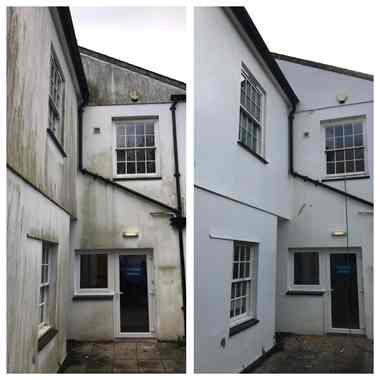
Sunlight is the control
Algae and lichen need moisture. What kills them off, more than anything anyone applies, is a wall drying out properly between showers. Direct sun does that; shade does not.
A south-facing wall in Dorset gets several hours of drying sun even in midwinter. A north-facing wall at this latitude can go from October to March without direct sunlight touching it at all. That is five months of a surface that never fully dries, in the wettest part of the year. Growth does not just survive there — it thrives.
The difference is stark enough that people often assume something is wrong with that wall. Usually there is not. It is simply facing the wrong way.
What makes it worse than aspect alone
Aspect sets the baseline. These push it further:
- Trees and tall hedges shade the wall and raise the humidity immediately around it. A north wall behind a mature hedge is the worst case in the county.
- Sheltered valley positions. The Blackmore Vale holds damp air. Properties down in it green up faster than exposed ones up on the ridge — which is why a house near Sturminster Newton often has more growth than one up at Shaftesbury, despite Shaftesbury taking far more weather.
- Narrow gaps between buildings. A passage down the side of a house barely dries at all.
- Textured surfaces. Pebbledash, roughcast and riven stone hold water in every hollow. Smooth render dries faster.
- Anything leaking above. A dripping gutter joint turns a slow problem into a fast one. Covered in our autumn gutter guide.
What you can change, and what you cannot
You cannot rotate the house. But the picture is less fixed than it looks, because most of what accelerates growth is fixable.
Get light and air to the wall. Cutting a hedge back by a couple of feet, or lifting the crown of a tree, changes the drying time on an elevation dramatically. This is the single most effective thing most people can do and it costs nothing but an afternoon.
Fix the water. Clear gutters, sort leaking joints, make sure sills throw water clear of the face, and keep soil and mulch from banking up against the wall.
Accept the cycle on the worst elevation. A north wall under trees may want attention every two to three years while the sunny sides go five or more. That is not a failure of the cleaning — it is the aspect, and anyone promising otherwise is overselling.
Cleaning it without causing damage
The instinct with a badly greened wall is to hit it hard. That is precisely the wrong move on render, and worse still on the soft Ham stone around Sherborne and Castle Cary.
Softwashing is a chemical process rather than a pressure one: a biocide applied at very low pressure that kills the algae, lichen and bacteria living in the surface, so nothing is scoured off and the material underneath is untouched. The dead growth then breaks down and weathers away over the following days. Full detail on the render cleaning page and in softwashing vs pressure washing.
Worth knowing before you book
A shaded north elevation often looks patchy for a week or two after treatment, and keeps improving well after we have left. On a sunny wall the change is faster because there is less biomass to break down. Both are normal; the north wall simply had more growing on it.
Is green growth on a wall actually damaging?
Mostly it is cosmetic, but it holds moisture against the surface, and persistently wet render or stone deteriorates faster in frost. Lichen roots into the surface texture and is harder to remove the longer it is left.
Can I just do the north wall?
Yes, and plenty of people do. It is usually the one that bothers them and often the only one that needs it.
Will cutting the hedge back really make a difference?
A significant one. Light and airflow are what keep growth down, and more of both on that wall extends the time between cleans noticeably.
One wall letting the house down?
Send a photo of the worst elevation and we will tell you what is causing it and what it would cost to put right.