
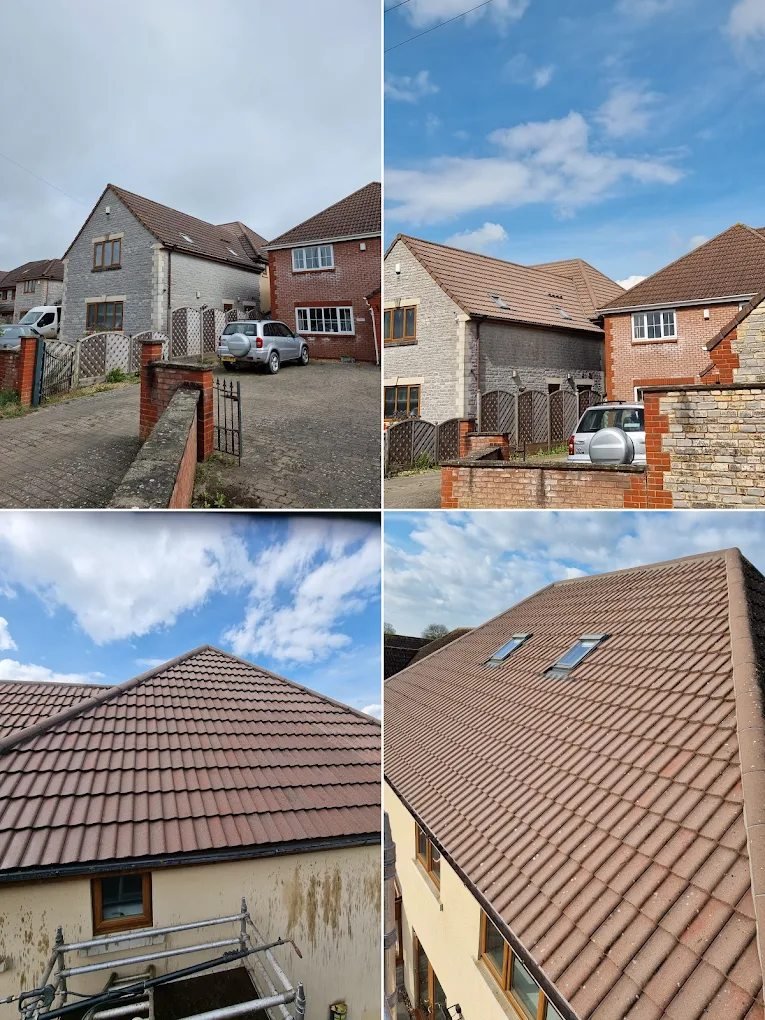
Why your roof and not next door’s
Moss needs three things: moisture, shade and something to hold onto. Where all three line up, it thrives; where any one is missing, it struggles. That is why one side of a roof can be furred green while the other is nearly clear.
- North-facing slopes stay damp for hours longer each day and never get the drying sun that kills growth off.
- Overhanging trees shade the roof, drop organic debris that holds water, and keep humidity high underneath.
- Older concrete tiles lose their dense factory face over time and become porous, which gives moss somewhere to root.
- Sheltered valleys — and the Blackmore Vale is one long example — hold damp air, so growth is heavier here than on exposed hilltop sites.
- Blocked gutters keep the lowest courses of tiles permanently wet, which is where moss usually starts.
None of this means anything is wrong with your roof. It means your roof is in Dorset.
What moss actually does up there
Most people ring us because the roof looks bad, and that is a perfectly good reason. But the reason we would ring you is different.
Moss holds water against the tiles. A saturated moss cushion sitting in the laps keeps the tile surface wet for days after rain has stopped. When that water freezes, it expands, and it takes a bit of the tile with it every time. Frost damage on a mossy roof is measurably worse than on a clear one, and in a county that gets a decent run of frosts every winter, that compounds.
It breaks off and blocks things. Moss does not stay where it grows. It sheds into the gutters, packs the downpipes, and then rainwater goes over the edge and down the wall instead of into the drain. That is how you end up with green-streaked render, damp patches at ground floor level, and a repointing bill that has nothing to do with the roof.
It works its way into the laps. Thick growth can lift the bottom edge of a tile slightly and hold water where the overlap should be shedding it. Not catastrophic on its own, but not something you want left for a decade either.
Why the quick fixes do not work
Scraping it off
Physically removing moss does work — for about eight months. Scraping takes the visible cushion away but leaves the spores and the root structures in the tile surface completely intact, so regrowth starts from an established foothold rather than from nothing. A scraped roof is often visibly greening again by the following autumn.
Pressure washing
This is the one that causes real damage. High pressure will certainly take the moss off, and it will take the tile’s protective face off with it, dislodge tiles, and force water sideways under the laps. The roof looks superb on the day. Two or three winters later the tiles start shaling and shedding grit into the gutters, and the person who did it is long gone. We wrote about this in more detail in softwashing vs pressure washing.
Moss killer sachets and gutter tablets
Harmless, and occasionally they help a little at the very top of a roof where rain washes the product down the slope. They are nowhere near a substitute for treating the whole surface, and they do nothing at all for the growth already established lower down.
Zinc and copper strips
There is real science behind these — metal salts washing down the slope do inhibit growth. In practice they only protect the area directly below the strip, they work slowly, and they do nothing about what is already there. Useful as a supplement on a clean roof; useless as a cure.
How it is done properly
A roof clean that lasts is three separate jobs, done in order.
- Hand clearing from safe access. The bulk of the moss comes off by hand from a scaffold tower or a safe working platform — not blasted, and not reached by leaning off a ladder.
- Low-pressure softwash. Hand clearing always leaves algae, lichen and staining behind. A softwash lifts what is left without any mechanical force on the tile.
- Gutters and downpipes cleared. A roof clean sends a lot of material downwards. Clearing it is part of the job, not an optional extra to be quoted separately.
- Biocide treatment. This is the part that decides whether you are doing it again in a year or in several. It kills the organism rather than removing it, so regrowth has to start from scratch.
Ground protection matters too — borders, ponds, drains and paths covered while the work happens and washed down before we leave.
How long it lasts
A properly cleaned and treated roof will typically stay clear for several years rather than several months. The variables are the ones you would expect: a south-facing, open roof with no trees near it will stay clean far longer than a north slope under a beech. Nobody can honestly give you a number without seeing the roof.
What you can take as a rule of thumb: if someone tells you a roof needs doing every year, either they are not treating it or they are selling you a subscription.
One important exception. Older cement-fibre roof sheeting — common on garages, outbuildings and farm buildings — may contain asbestos. It should never be scraped, brushed or pressure washed, because disturbing it releases fibres. If you have a corrugated cement roof and you are not certain what it is, do not let anyone clean it until it has been properly assessed.
When a roof should be left alone
Cleaning is not always the right answer. If tiles are already spalling or delaminating, if there is previous pressure-washing damage, if the ridge or valleys need attention, or if the roof is near the end of its life, cleaning it will make the situation worse and spend money that should go towards the repair.
The same applies to render and stone below it. We would rather tell you that and lose the job than take payment for something that damages the building.
What affects the price
There is no useful price list for roof cleaning, because the job varies enormously. What moves the number is: the size and pitch of the roof, how bad the growth is, how many elevations there are, the access — whether a tower can be got to the right places — and whether the gutters need serious clearing as well.
A couple of photos taken from the ground is normally enough for an accurate fixed price without anyone visiting. That is how most of our roof cleaning jobs get quoted.
Will cleaning the moss off damage my tiles?
Not if it is done by hand and softwashed. It absolutely will if it is done with a pressure lance. The method is what decides it, not the cleaning itself.
How long before the moss comes back?
Several years on a treated roof, assuming reasonable light and no heavy overhanging trees. Shaded roofs under trees regrow faster no matter what is done to them.
Do you clear the gutters as part of it?
Yes. A roof clean pushes a lot of material into the gutters, so clearing them is included rather than added on afterwards.
Do I need to be at home?
Not usually, as long as we can get access to the roof and there is an outside tap. We will let you know when we arrive and when we are finished.
Is it worth doing before selling a house?
It is one of the few jobs that changes the look of a whole property for a comparatively small sum, and a mossy roof reads to buyers as neglect whether or not the roof is sound. Most people are surprised how much lighter the tiles are underneath.
Read next, or get a price.
Roof looking green?
Send a photo from the ground and we will come back with a fixed price within 24 hours — and an honest answer about whether it needs doing at all.