
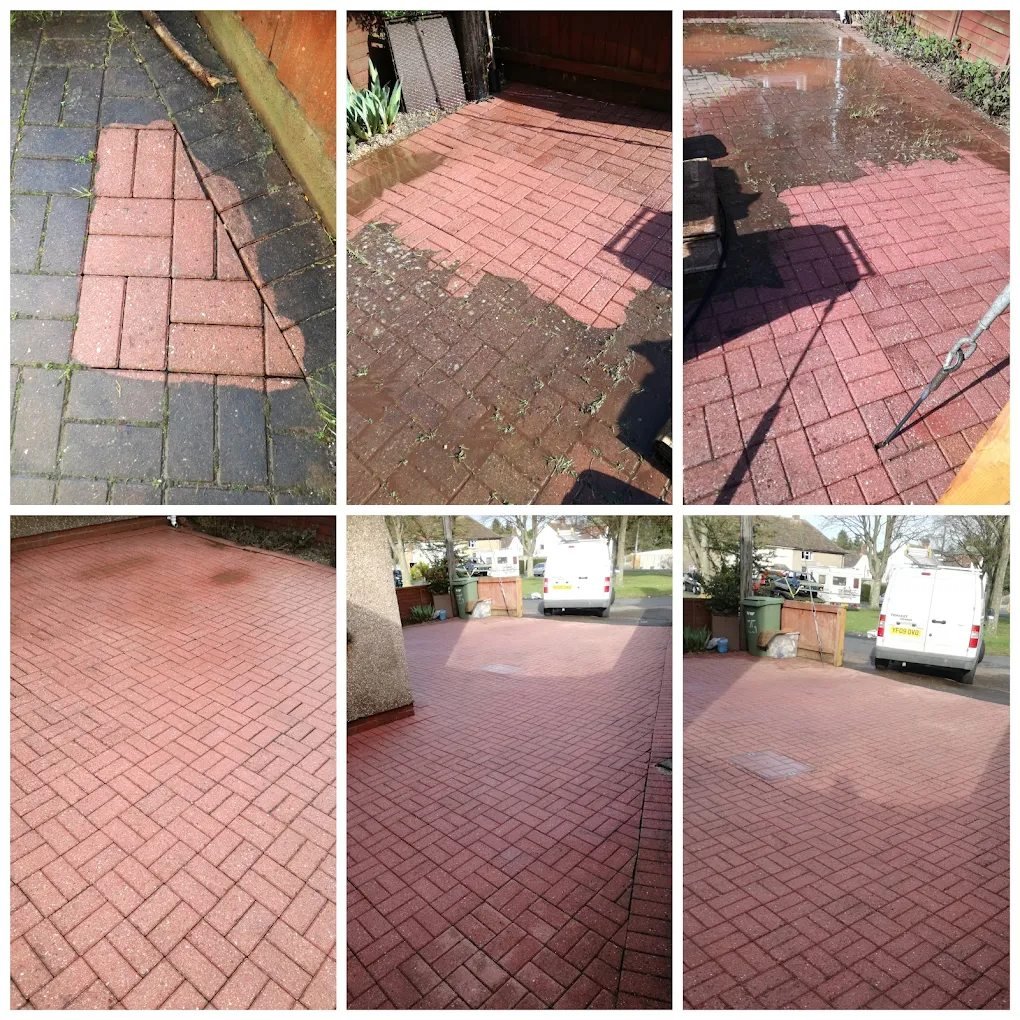
The joints are the driveway
Block paving is not held together by the blocks. It is held together by the kiln-dried sand packed into the joints between them. That sand locks every block against its neighbours so the whole surface behaves as one interlocked slab and spreads the weight of a car across it.
Lose the sand and the blocks become individual pavers sitting loose on a bed. They rock, they tilt, water gets underneath, and the sub-base starts washing about. Almost everything that goes wrong with a block drive starts here.
Why weeds grow in the joints
People assume weeds push up from the soil beneath. They almost never do — there is a compacted sub-base and a sand bed in the way. What actually happens is that seeds and organic debris blow in and settle in the top of the joint, and once the sand has slumped a few millimetres there is a perfect little seed tray running the length of every line.
That is why weeding without re-sanding is a fortnight’s work for a season’s result. The seed tray is still there. Fill the joints properly and there is nowhere for the next seed to land.
Why the blocks go green
The green film is algae, and it needs the same things it needs everywhere else: moisture, shade and a surface with a bit of texture. Concrete blocks lose their dense factory face over the years and become progressively more porous, which gives algae somewhere to sit.
You will usually see it worst where water lingers — the shaded side of the house, under a hedge, along the low edge where the fall runs, or in a dip that never quite drains. It is also what makes a drive genuinely slippery in winter, which matters more than the look does.
Sinking, rutting and wandering edges
Three different problems that get lumped together:
- A rut where the car parks is usually sand loss plus consolidation. If the blocks are sound and the dip is shallow, cleaning and re-sanding can settle it down considerably.
- Blocks spreading outwards at the edge means the edge restraint has failed — the haunching concrete under the edging course has cracked or the edging has moved. That is a laying job, not a cleaning job.
- A genuine hollow that holds water after rain suggests the sub-base has washed or settled. Cleaning will not fix it; that section wants lifting and relaying.
Worth knowing which one you have before you pay anyone to clean it, because two of the three need a different trade.
How a drive is properly cleaned
Block paving is one of the surfaces that genuinely wants pressure — it is dense, hard and sacrificial, and there is no delicate coating to protect. The care is in the sequence, not in the caution.
- Weeds and moss cleared first from the joints, including the edges and corners where they are most established.
- Washed at an appropriate pressure across the whole surface — evenly, so you do not get the striping that comes from a rushed rotary pass.
- Edges, kerbs and corners done by hand. This is where a rushed job always shows, and it is the first thing your eye goes to from the road.
- Debris and slurry removed rather than pushed into the borders or the drain.
- Kiln-dried sand brushed back into every joint once the surface is dry, and worked in properly rather than swept over the top.
The sand has to go in dry, which means the drive needs to have dried out first. On a job done in one visit that usually means cleaning in the morning and sanding later the same day — and in a wet week, coming back.
Should it be sealed?
Sometimes. Sealing a block drive after cleaning and re-sanding stabilises the joints, slows weed and algae return and makes future cleans easier. It also darkens the colour, which some people like and some do not, and it needs redoing every few years.
What matters more is when not to seal. A drive that is still holding moisture underneath should not be sealed, because you trap the water in. Neither should one that is about to be relaid, or one where the blocks are already failing. If someone offers to seal a drive on the same day they cleaned it in October, be suspicious.
Mistakes worth avoiding
- Household bleach or salt on the joints. It kills the weeds and it also runs off into the borders and the drain. There are better options that do not sterilise the flowerbed.
- Holding a turbo nozzle in one place. Concrete blocks will scar, and the mark does not come out.
- Washing everything into the drain. A driveway’s worth of sand and silt in a gully is somebody’s blocked drain in six months.
- Sanding a wet drive. The sand clumps at the top of the joint instead of packing down, and it washes out again with the first heavy rain.
- Cleaning a drive that needs relaying. A properly cleaned failing driveway is a very clean failing driveway.
Other hard surfaces, briefly
Concrete takes pressure well and simply needs an even pass. Natural stone patios are a different conversation — sandstone and limestone are far softer than concrete blocks and want the pressure dialled right back, which is covered on our patio cleaning page. Tarmac cleans up well but loses colour in the process, so a black restorer goes back on afterwards; that is the whole point of tarmac cleaning and re-colouring.
What it costs
Driveway cleaning is priced on area, condition, how much weed and moss growth there is, and whether re-sanding and sealing are included. A photo or two from the house end and a rough size is normally enough for a fixed price on driveway cleaning, without anyone needing to visit.
Do you re-sand the joints afterwards?
Yes, with kiln-dried sand once the surface has dried. Cleaning without re-sanding leaves the blocks unlocked, which is worse than not cleaning at all.
Will pressure washing damage my block paving?
Not at a sensible pressure with the nozzle kept moving. Damage happens when a turbo head is held in one spot, which scars the concrete face permanently.
How long until the weeds come back?
With the joints properly filled, considerably longer than most people expect — the seeds have nowhere to settle. Sealing extends it further again.
Can you fix the dip where the car sits?
A shallow dip from sand loss often improves a lot with cleaning and re-sanding. A real hollow means the sub-base has moved, and that section needs lifting and relaying — we will tell you which you have.
How often should a drive be done?
Every couple of years for most properties. Shaded drives under trees or on a north side will want it more often.
Read next, or get a price.
Drive looking tired?
Send a photo and we will come back with a fixed price within 24 hours — cleaning, weeding and re-sanding included, not bolted on afterwards.