
Home / Roof Cleaning
Roof Cleaning & Softwashing in Somerset & Dorset
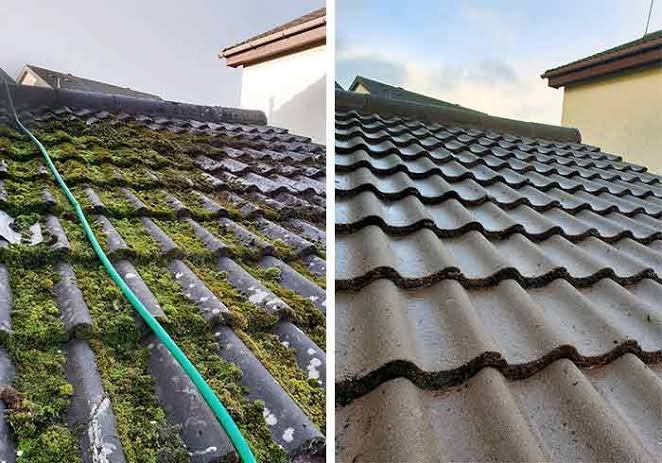
Moss, lichen and algae removed from your roof without a pressure washer ever touching a tile. Softwash and hand clearing only, finished with a biocide treatment so the regrowth stays away for years rather than months.
Roof softwashing, done the safe way.
A tiled roof is not a driveway. Put 3,000 psi through it and you will strip the surface off the tiles, force water under the laps and shorten the life of the whole roof. We do it the slow way instead.
Every roof starts the same way: moss and lichen cleared by hand from a safe access platform, never blasted off. Once the bulk of it is down, the whole roof gets a softwash — which is a chemical process, not a pressure one. A biocide applied at very low pressure kills the algae and lichen rather than blasting them off, lifting the staining that hand clearing always leaves behind.
Gutters and downpipes are cleared of the debris that comes down with it — that is part of the job, not an extra we add on afterwards. We finish with a biocide treatment so regrowth is held back for years rather than months, and the ground, borders and drains stay protected throughout and get washed down before we leave.
Three steps, no surprises.
Send a photo
A picture of the roof from the ground is usually enough for us to see what we are dealing with and quote it properly.
Get a fixed price
A clear written price with nothing hidden — and an honest answer if your roof would be better left alone.
We clean it
Usually a single day. We protect the surrounding areas, clear the debris away and leave the site tidy.
Biocide roof treatment: what makes it last.
Clearing growth off a roof and treating a roof are two different jobs, and only one of them lasts. Scraping or washing moss away deals with what you can see. What is living down in the pores of the tile is untouched, which is why an untreated roof looks green again within a season or two.
The biocide roof treatment is the part that changes that. Applied at low pressure across the whole roof, it kills what is growing in the surface rather than removing what is sitting on top of it. The dead growth weathers away gradually over the following weeks and the tiles stay clear for years rather than months.
It is included on every roof we clean across Somerset and Dorset, not sold as an extra afterwards. There is more on why in our guide to getting rid of roof moss properly.
Houses, units and bigger roofs.
Most roof work is domestic, but we take on commercial roof cleaning in Somerset and Dorset as well — industrial units, farm buildings, shop and pub roofs, and blocks where the gutters have not been looked at in years.
The method does not change with the size of the roof: hand clearing, a low-pressure softwash and a biocide treatment. What changes is access and scheduling, and those get worked out when we quote rather than being sprung on you on the day.
On a commercial building the gutters often matter more than the roof itself — here is why blocked gutters do the real damage.
Lichen is the part that fights back.
Moss comes away by hand. Lichen does not. Those flat grey, yellow and orange crusts grow down into the surface of the tile, so scraping takes the top off and leaves the rest to regrow from exactly the same spots — and scraping harder starts taking the tile with it.
That is why roof lichen removal is really a treatment job, not a cleaning job. The low-pressure softwash and biocide kill the lichen where it is anchored, and the dead crust then loosens and weathers off over the following weeks. If your roof still looks speckled the day after we leave, that is normal; it is the treatment working. Our guide to why lichen will not scrape off goes into more detail.
Damp valleys, soft stone.
South Somerset is close to perfect lichen country. Low, damp ground around Martock and Somerton, sheltered valley sides at Bruton and Castle Cary, and mature trees over a lot of roofs mean tiles stay wet for long periods, especially on north-facing slopes.
Around Yeovil most roofs are concrete or clay tile over estate housing, where softwashing is straightforward. In the older stone villages the same rule applies with extra care: no pressure on the roof, borders and drains covered, and an honest word if a roof would be better left alone.
Questions, answered straight.
Is softwashing a chemical treatment?
Yes — that is exactly why it works without pressure. A biocide is applied at very low pressure and kills the moss, algae and lichen living on the tiles; nothing is blasted off, so the tile surface underneath is left untouched. The dead growth then breaks down and weathers away over the days and weeks that follow. It goes on at the correct dilution, with borders, planting and drains covered first and everything washed down before we leave.
Will pressure washing damage my roof?
Yes, and badly — which is exactly why we do not use it. High pressure strips the protective surface off concrete tiles, dislodges them and drives water under the laps. Roofs get a softwash and hand clearing only.
Why does moss matter? It looks harmless.
Moss holds water against the tiles, which accelerates frost damage in winter. It also breaks off and blocks gutters and downpipes, which sends water down your walls instead of into the drain. It is a maintenance problem long before it is a cosmetic one.
How long before the moss comes back?
The clean alone is not the answer — the biocide treatment afterwards is. Treated roofs typically stay clear for several years. Heavily shaded roofs under trees will always regrow faster than open, sunny ones.
Do you clear the gutters as well?
Yes. A roof clean pushes a lot of material into the gutters, so clearing them is part of the job, not an extra.
Do you do commercial roof cleaning?
Yes — industrial units, farm buildings, shop and pub roofs and similar. Same method as a house roof: hand clearing, a low-pressure softwash and a biocide treatment. Access and scheduling get agreed when we quote.
What biocide do you use on a roof?
A professional roof biocide applied at the correct dilution for the surface. It is designed to kill moss, algae and lichen in the tile rather than strip anything off it, which is what makes the result last. Borders, planting and drains are covered before it goes on and everything is washed down before we leave.
How do you remove lichen from a roof?
By treating it rather than scraping it. Loose moss is cleared by hand, then the roof gets a low-pressure softwash with a biocide that kills the lichen anchored in the tile. The dead lichen loosens and weathers away over the following weeks.
What is a biocide roof treatment?
A treatment applied across the whole roof at low pressure that kills moss, algae and lichen living in the surface of the tiles, rather than just removing what sits on top. It is what keeps a roof clear for years rather than months, and it is included on every roof we clean.
Do you cover my part of Somerset?
We work right across South Somerset, including Yeovil, Martock, Somerton, Castle Cary, Bruton and Wincanton and the villages between them. Send us your postcode with a photo and we will confirm.
Do I need to be at home?
Not usually, as long as we can get access to the roof and there is an outside tap. We will let you know when we arrive and when we are done.
We also clean…
Areas we cover.
Based near Sturminster Newton and working right across North Dorset and South Somerset. Pick your town for the local detail, or just ask — if you are anywhere near this list, you are in it.
Ready to see the difference?
Send a photo of your roof and we will come back to you with a clear, fixed price within 24 hours. Free, no obligation, no pressure.